
Voices from the Threshold #10
M.P Strayer


M.P. Strayer is a literary author whose story, Poetry, captivated me with its haunting fusion of natural beauty and emotional devastation. Rather than treating trauma as something to be explained, his fiction immerses the reader in its fractured logic, where memory, grief, and landscape become inseparable.
In this interview, we discuss poetry, trauma, Southern Gothic, anime, Stephen King, Cormac McCarthy, storytelling, civilisation, and why the truest stories often emerge when writers stop trying to control them.
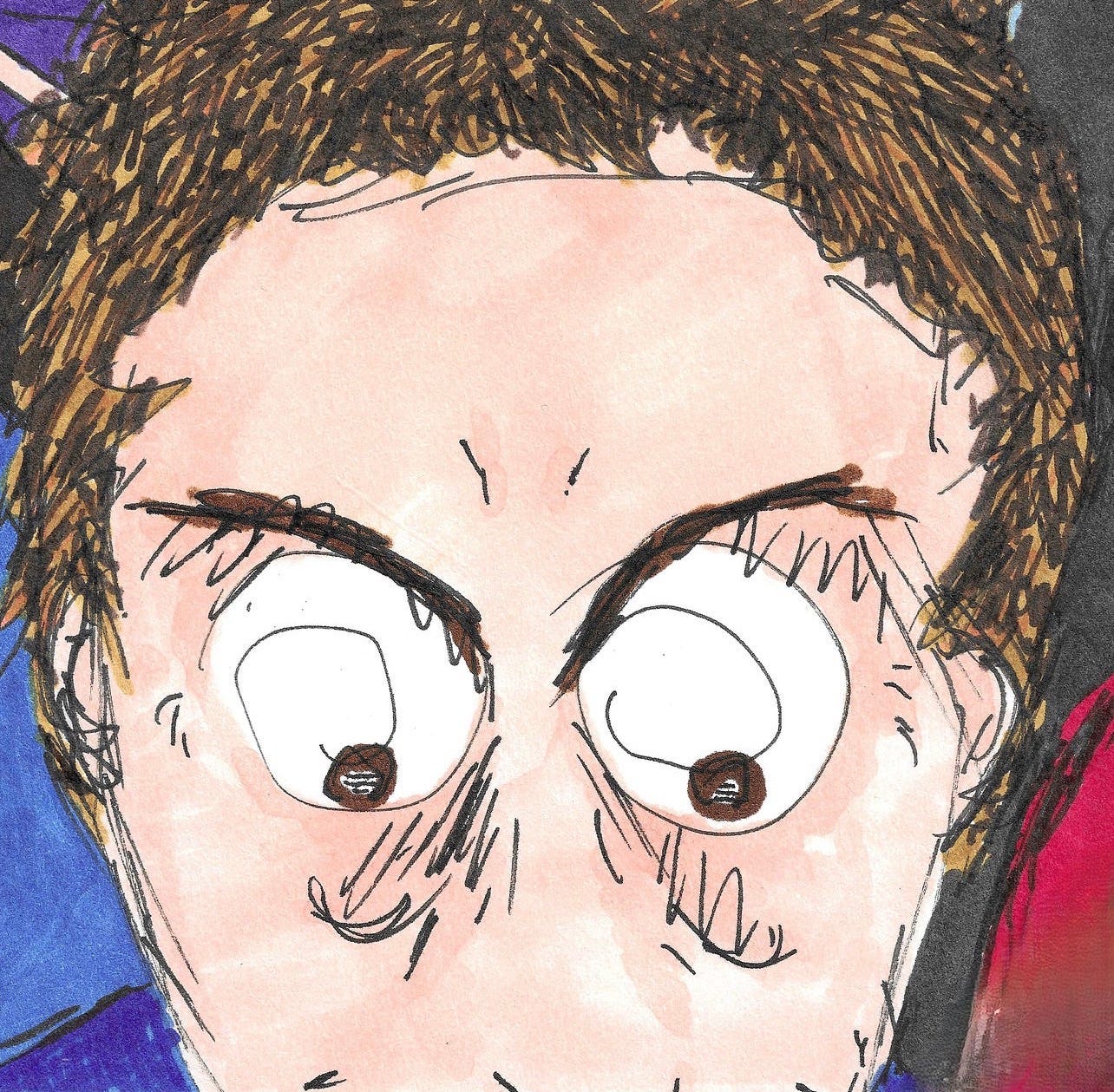
The author:
M.P. Strayer’s work has appeared in more than seventy publications, most recently Aethlon: the Journal of Sports Literature, Bare Back Magazine, and Zoetic Press. He resides in Corvallis, Oregon.
Thanks for doing this interview, M.P.
I appreciate the opportunity. Call me Mike.
I really enjoyed reading your work. What struck me most was your ability to fuse beautiful natural imagery with profound emotional pain. Poetry felt almost dreamlike at times, yet every detail carried an unmistakable weight. Where exactly does that approach come from? And what do you think poetry and lyrical prose allow you to express that more direct storytelling doesn’t?
That particular story was written in the fall of 2013 and, in this case, I think I let the title dictate the form a bit. The title came first and it allowed for a certain creative license. In all my work, for a long time now, I’ve tried not to focus too much on the distinction between poetry and prose. No one can read All the Pretty Horses and tell me it’s not replete with poetry. Conversely, for me, it’s the poem written in the simplest, most straightforward language—that has something to say, and actually says it—that hits the hardest. Trauma imprints on us in a number of ways. Memories come out of order, or blurred, or with surreal precision. With “Poetry” I wanted the reader to experience that incongruity of horror and sunshine.
Story is story. I used to be obsessed with ideas of style, but now I just try my best to tell the damned thing, to trust the Muse and the decades of life I’ve spent working on my craft to convey the narrative.
That leads into my next question—what’s the core aim of your fiction? What are you trying to make the reader feel, confront, or experience? What gap are you trying to fill?
Well, I guess I always want readers to come away with a feeling they’ve experienced something, to have undergone a journey of some kind, that they’ll remember going forward. Something true, even if it’s completely made up--which requires aesthetic fidelity. But I sit down at this machine whether or not anybody ever reads the words; there’s no gap I’m trying to fill. If I can be a light, an escape, a sense of communion with something larger, if I can contribute to a cultural memory, that’s great. But I’m never trying to direct my stories, nor how people interpret them. I listen to the Muse. The story is boss. I think Stephen King said that.
As a writer, who are your biggest influences?
On that note: Stephen King surely. I think my earliest and most enduring models of what a storyteller is or can be derive from King, J.R.R. Tolkien and C.S. Lewis, whose works my mother used to read to me at bedtime. But I think the single greatest influence on my art is Akira Toriyama; the discovery of Dragon Ball, and anime more broadly, marked a turning point in my life, in the kinds of stories I wrote and ingested, how I saw the people I wrote about in my mind’s eye, in the colors I used, the violence, the big emotions, the transformations, the awesome fight scenes. My love of anime has never left.
Other turning points were, in no particular order, the discoveries of Dante, Cormac McCarthy, Junot Diaz, Ernest Hemingway, and W.S. Merwin. Louise Erdrich continues to exemplify an artistic standard I aspire to. I adore Toni Morrison, and Beloved will always have a place on my shelf. Reading William Styron is always humbling. Ditto Peter Matthiessen and Mary Oliver. Christ there are so, so many. Denis Johnson, Charles Bukowski. Herman Hesse’s Siddhartha was a significant find for me as a teenager. I used to ramble around California writing about regional MMA—my experiences as a martial artist, it occurs to me now, also played a huge role in my development—and A.J. Liebling’s The Sweet Science was never out of reach.
So many.
What’s your opinion on modern literature as it currently stands?
Some of it I like, such as Daniel Kraus’s Angel Down, which (deservedly) won a Pulitzer Prize this year.
Some of it I don’t.
Identity and story are not synonymous.
And what about the age we live in more broadly? Does the world feel stranger to you lately? More unstable? More surreal?
I think surreal is an apt word—but I have to constantly remind myself that, despite some unprecedented changes (such as the proliferation of social media and LLMs), I imagine every generation not preoccupied with killing a mammoth has thought they were living through strange times. Most of the things people around me are so concerned with, that they think are so incomparably important, I consider ephemeral.
My biggest fear is astronomical impact.
My biggest hope (fantasy, really) is that we’ll achieve a society wherein we’ve collectively agreed to stop killing each other in mass and in which folks are left more or less to their own devices.
What’s the greatest moment in your life been so far?
The discovery of Delirium Tremens Belgian Ale.
What’s the most challenging one been? And what did you learn from it?
I’m still working that out.
How do you balance your creative ambitions with the rest of your life?
Poorly, I must admit. When I’m working on something, the project occupies great space in my mind, and leeches out into pretty much every aspect of my day-to-day until it’s done.
My life is structured around my practice. Truly. I have not “made room” for it. I make room for everything else.
If someone discovered you through this interview, what’s the one piece you’ve posted on Substack that you’d point them toward first?
“The Incredible Coffee-Making Hound.”
Alright—you get the last word. How would you like to sign off? What would you want to say to the people reading this?
Thank you so much. If any of you out there are inspired to read my work, I hope you get something out of it (also: re-stacks go a long goddamn way in this place).
Cheers!
If M.P. Strayer’s answers resonated with you, be sure to subscribe to his Substack and do go check out “The Incredible Coffee-Making Hound.” There’s a lot more going on beneath the surface than we could ever cover in a single interview.
Besides, now it’s your turn.
Which of M.P. Strayer’s answers struck you hardest? Which did you agree with? Which did you disagree with? And what question do you wish I’d asked?
Drop your thoughts below and let’s give Mike a proper grilling in the comments. ↓
 | A guest post by
|
Thanks again, Tiberius. Much appreciated.
I love the comment about how you don’t make room for your writing, you make room for everything else. Really puts it into perspective for me about how important writing (or art in general) should be if you call yourself an artist. Makes for some harsh introspection. Thanks for doing this interview!