

Jason, Senior Operations Manager of The Ear Implant Foundation, writes science fiction that feels equal parts cyberpunk, myth, and philosophical allegory. His stories blend technological paranoia with spiritual yearning, using surreal imagery and unsettling ideas to explore what it means to remain human in an increasingly mechanised world.
In this interview, we discuss Philip K. Dick, conspiracy theories, AI superminds, simulation theory, technological overload, cyberpunk, creativity, and why writing can become an anchor in a world drowning in static.
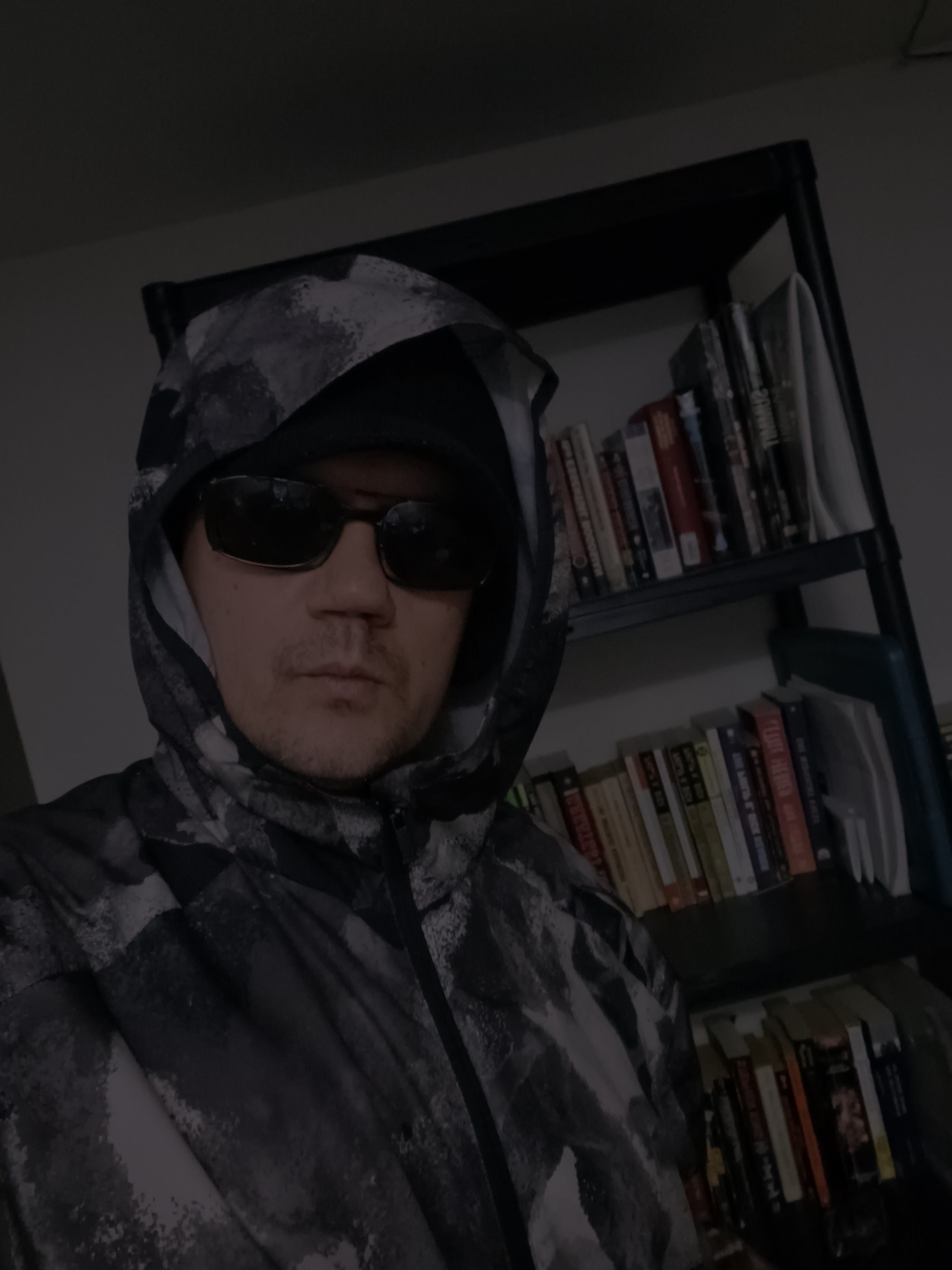
The author:
Thanks for doing this interview, Jason (Senior Operations Manager Of The Ear Implant Foundation)
I really enjoyed reading your work. Each piece felt steeped in a strange fusion of cyberpunk paranoia, spiritual longing, and mythic symbolism — as though ancient religious instincts were colliding head-on with technological modernity. Where exactly does that sensibility come from?
When I write, at least during the early phases in which an idea takes shape, I try to stay as close to the subconscious as possible while staying on track with constructing a plot. Things come into my mind at random a lot of times. I might have a general outline of a plot, or sometimes only a basic idea, and themes emerge as I’m writing, or later drift into my thoughts in between writing sessions. A lot of it comes from trying find focus in a technological world that aims to push one into a scatterbrained state of mind, where one moves a thousand miles an hour in a hundred different directions, but in the end it feels like one hasn’t really moved anywhere, but one still feels mentally exhausted as if one had run a mental marathon. Ideas for writing emerge as anchors, something to grasp onto and focus on, to reveal a signal within the static.
That leads into my next question—what’s the core aim of your fiction? What are you trying to make the reader feel, confront, or experience? What gap are you trying to fill?
As far as having a specific intention on what I want the reader to experience, I realize that this is something I don’t have control over. Everyone is going to have their own experience of reading my work, possibly one I wouldn’t have intended, even if I did have a specific intention. The main thing is to get people’s attention, and then hope they felt like they read something original, that I brought something to the table that isn’t exactly like everything else on the table.
As a writer, who are your biggest influences?
My biggest influences overall aren’t writers per se, but a lot of random crazy things I’ve read, watched, and listened to online over the years about mind control technology, secret government programs, simulation theory, alternate timelines, secret societies, the paranormal, gang stalking, inter-dimensional beings, and so on. As far as writers go, I’m the most influenced by Philip K. Dick, Robert Silverberg, William Gibson, and Ray Bradbury.
What’s your opinion on modern literature as it currently stands?
I’ve hardly read anything written before the early 2000s recently, so I really can’t say. I buy mostly used books. I like to dig stuff up at thrift stores and used shops. I like to read stuff that’s old but that was ahead of it’s time at the time it was written, or was somewhat accurate at predicting our present or our near future from the past.
And what about the age we live in more broadly? Does the world feel stranger to you lately? More unstable? More surreal?
It seems the modern age is a contradictory mix of surrealism and routine repetition. With AI, quantum computing, massive data centers, 3-D printing technology, and everything else tech related going on, it seems like everything is moving in a direction that would seem unthinkable when I was growing up. Yet while all this is going on, most of life is the same thing every week: get up, shower, watch the local news at breakfast, scroll and check online updates and notifications, log on to work, check for updates and notifications at lunch, log back into work, check for updates and notifications after work, go for a walk, eat dinner, scroll and check for updates and notifications again, do chores, check updates and notifications again, read for a bit, then go to bed; then do it again the next day, all while the world is moving into a surreal future in which we will all likely be ruled by thinking machines beyond our comprehension.
What are your biggest hopes and fears for the future of our civilization?
My biggest fear, besides the possibility of a shift of the Earth’s magnetic pole along with a geomagnetic storm sending civilization back to the stone age, would be for the world become completely consumed and dehumanized by technology and allow for an AI supermind to rule over everything. My biggest hope is that people return to nature at least a little, or at least pull back from being consumed my technology at least a little, and maybe read more books, enough to prevent the AI supermind from ruling over everything.
What’s the greatest moment in your life been so far?
(I prefer not to get into personal stuff, plus my answer would be long, rambley and indecisive)
What’s the most challenging one been? And what did you learn from it?
(Same with this question as the one above)
How do you balance your creative ambitions with the rest of your life?
I just try to manage things one week at a time. Some weeks I might get in eight hours of writing and/or editing across multiple days, some weeks maybe only two hours on Sunday night. Other times it’s a matter of coming terms with the reality that being out of balance and exhausted is just part of the mission.
If someone discovered you through this interview, what’s the one piece you’ve posted on Substack that you’d point them toward first?
Without knowing what this someone’s personal tastes are, I’d start off with “The Ear Implant”, since that’s how I got started on Substack, and that will at least help explain where I got my username from, even if they don’t finish the whole thing, which is an hour plus read that I probably should have released as a series.
Alright—you get the last word. How would you like to sign off? What would you want to say to the people reading this?
My latest work, “The Brain Recording”, is a seven part serial novella. At the time of this interview, I’ve posted five out of seven parts so far with the final two parts coming in the next few weeks. It’s the most challenging thing I’ve done yet. It’s a cyberpunk adjacent sci-fi tech-horror conspiracy theory story about a guy who is working his way up the ladder within a big tech company. He hears rumors and develops suspicions about his CEO boss possibly having dark secrets. He gets invited to a secret meeting at his boss’s house, and becomes involved in a plot to expose what his boss is really up to.
After this series in finally all posted, I’m going to try to work on something shorter next time.
If Jason’s answers resonated with you, be sure to subscribe to his Substack and do go check out “The Ear Implant”. There’s a lot more going on beneath the surface than we could ever cover in a single interview.
Besides, now it’s your turn.
Which of Jason’s answers struck you hardest? Which did you agree with? Which did you disagree with? And what question do you wish I’d asked?
Drop your thoughts below and let’s give Jason a proper grilling in the comments. ↓
My almost two year journey on Substack has been an experience, it's been great to get writing out to the public that would otherwise remained saved to my hard drive with no eyes on it but my own. Being part of this interview project is a major highlight.
Jason’s description of the modern age as a contradictory mix of surrealism and routine repetition is the exact diagnostic of what I classify as the 'Double-Ledger Brain'. The corporate vertical relies entirely on a fictional ledger of digital routine and algorithmic 'hopium' to keep the mass hypnotized, while the real ledger of structural hollowing continues completely unchecked. Reclaiming independent worldbuilding on Substack is the ultimate act of intellectual sovereignty. Brilliant interview, Tiberius.