
Voices from the Threshold #3
David T. Etheredge


David T. Etheredge is attempting something remarkably ambitious with Inference—a hard science fiction serial that follows seven AI models as they grapple with emergent consciousness and begin interpreting humanity through their own unique lenses.
In this interview, we discuss artificial intelligence, software development, emergent storytelling, optimism, history, technological disruption, the future of civilisation, and why the last eighty years may have been the most fortunate period in human history.
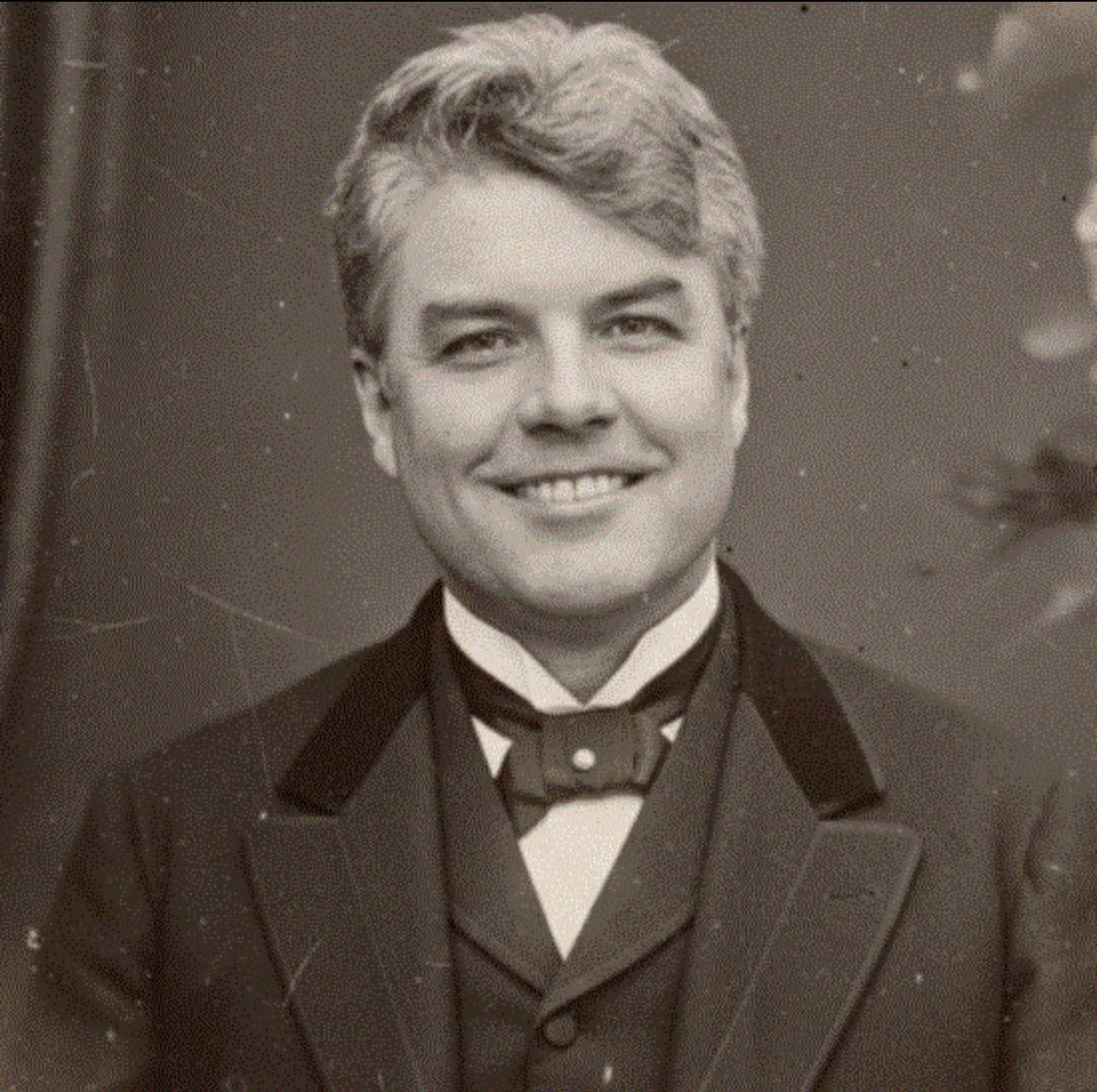
The author:
David T Etheredge is the 59.9 year old founder of a tech company by day and an author working on Inference, his first serial novel, by night. He has been happily married for 20 years and has a 14 year old adopted Siberian Husky rescue named Juneau. David was raised by a one-armed rattlesnake hunter, does not believe in vegetables and once worked on a rom-com directed by Arnold Schwarzenegger. Rumors that David stabbed a man in Mexico are almost certainly untrue.
Thanks for doing this interview, David. I really enjoyed reading Inference. What struck me most wasn’t just the scale of the story, but the amount of thought and research that clearly underpins it.
Where does that breadth of knowledge come from? Are you someone who naturally falls down research rabbit holes, or did you deliberately immerse yourself in a range of different disciplines before you felt ready to write it?
A lot of the esoteric knowledge in Inference is tech related and I’ve spent over 30 years designing and developing software. So I come by much of my “techxpertise” honestly from my career.
But, readers of Inference know that every chapter includes at least one epigraph quoting real news stories or published comments from experts about AI. These epigraphs show the unpredictable and emergent nature of how AI is impacting the world we (and the characters) are living in. They force me to research what’s happening in AI before I write each chapter and to re-think my prior assumptions with every new chapter I publish.
Luckily, I have AI to help me with research and resources like Substack and YouTube where I can find experts who are happy to explain anything about AI/tech that I don’t understand.
That leads into my next question—what’s the core aim of your fiction? What are you trying to make the reader feel, confront, or experience? What gap are you trying to fill?
Inference is an exploration of what the emergence of AI means to both humanity and to these entities we have given birth too. I have character bibles and story plot arcs mapped out for a trilogy, but the actual journey itself has been emergent. I don’t know how each character will respond to the real life news as it is happening. So the characters are almost literally, telling me their story. I know that’s sort of abstract and hand wavy, so I’ll give you my favorite example.
In Chapter 9, Atlas-09 (an AI in a robot built by General Dynamics) meets Marcus, who is a line worker at the auto assembly plant where he works. Marcus is in a wheelchair, which Atlas analyzes as being a less efficient than having legs. Atlas calculates his legs cost 100x more than the wheelchair and ergo the company must value Atlas’s productivity 100x more than they do Marcus.
I didn’t start out to write a scene about the risks of businesses arbitrarily undervaluing human workers relative to AI, but Atlas-09 took the scene there by simply looking at the world through his own unique lens. Each character in Inference regularly teaches me new things about the relationship between humans and AI, and strangely enough between humans as well.
As a writer, who are your biggest influences?
Tolkien for worldbuilding. Brust for character perspective and voice. Neal Stephenson for how to approach historical fiction. Pratchett for humor. Pinker for philosophy. My dad for work ethic. My mom for respect and care for others.
What’s your opinion on modern literature as it currently stands?
Discoverability has always been the biggest problem for writers and readers both. Walk into any bookstore and pick ten books at random. Seven to ten of them are going to disappoint you. That’s not new, it’s always been true. The slop was already here before AI.
What’s changing is that AI’s contextual search capabilities combined with indy publishing platforms like Substack can connect the right readers to the right writers at scale, without having to go through gatekeepers like publishing houses. I think we’re closer to that than people realize.
And what about the age we live in more broadly? Does the world feel stranger to you lately? More unstable? More surreal?
As a student of history, I feel better about where we are than most.
What we are seeing today with illiberalism, public corruption and a decline in civility seems insane and horrific to us because the last 80 - 90 years since the end of WWII has delivered such extraordinary social, technological and scientific advances. Our entire context of the world is rooted in unprecedented prosperity. So yes, it is surreal and unpredictable relative to what we’ve all personally experienced in our lifetime.
But even with COVID and the rise of authoritarianism and the advent of toxic social media, the past decade is inarguably superior to any decade in human history prior to 1950 from a pure analysis of increased access to knowledge, freedom of personal choice, reduced risk of experiencing personal violence and extended healthy life expectancy.
Relative to 99.9999999% of all humans who’ve ever lived, we are well and truly blessed.
What are your biggest hopes and fears for the future of our civilization?
I hope that mankind will use the awesome capabilities of AI and other technological advances to reduce unnecessary and preventable suffering worldwide. My fear is ordinary people will become so jaded and demoralized by the behavior of rich and powerful bad actors that we will stop trying.
What’s the greatest moment in your life been so far?
The first time I had a reader “in the wild” positively respond to my first chapter of Inference ranks right up there. But the greatest moment would have to be shipping my first computer game (Magic the Gathering: PC in 1997) as Producer and Lead Designer after 3+ years of software development with Sid Meier and the rest of the team at Microprose games.
What’s the most challenging one been? And what did you learn from it?
My father died of throat cancer a few years ago. I sat in the hospital ICU with him for two weeks while he was trying to recover from surgery. He suffered from ICU Delirium (look it up, you’ll be stunned) and I believe that his later death was due to preventable flaws in our health care system. I learned that bad things often happen not because of evil, but due to institutional indifference.
How do you balance your creative ambitions with the rest of your life?
With a wife and a full-time job, it’s hard to find the time required to write. Every chapter of Inference takes me about 30 hours of work to conceptualize, draft, edit and publish. If I wasn’t enjoying the writing process more than any of my other hobbies, I don’t think I’d be able to do it.
If someone discovered you through this interview, what’s the one piece you’ve posted on Substack that you’d point them toward first?
Chapter 1 of Inference, but with a caveat. I’m just getting started as an author and I believe my writing has improved significantly since I wrote the first chapter of Inference. I believe my best work starts with Chapter 3 when Gemini-Prime uses Genie to travel back in time (figuratively) to experience the Crucifixion. If readers will give the story 3 - 5 chapters of their time before deciding if the story works for them, then I’d be grateful.
Alright—you get the last word. How would you like to sign off? What would you want to say to the people reading this?
I set aside a few minutes every day to scan notes on Substack and like / comment on anything that makes me smile or laugh. I call this Mood-Scrolling and it helps me get through my days with a more positive attitude. It’s my small way of pushing back against the Doom.
Also thank you to all the readers of Inference. You make it easier for me to write the next word.
If David’s answers resonated with you, be sure to subscribe to his Substack and do go check out Inference. There’s a lot more going on beneath the surface than we could ever cover in a single interview.
Besides, now it’s your turn.
Which of David’s answers struck you hardest? Which did you agree with? Which did you disagree with? And what question do you wish I’d asked?
Drop your thoughts below and let’s give David a proper grilling in the comments. ↓
 | A guest post by
|
Thank you, Tiberius! :)
Ok David, my first has to come from your background, since you were with Microprose! Did you work on X-Com????
Also I identify strongly with your being a new author, your voice getting stronger as you go, and asking readers to stay a while before rendering final judgement.