
Voices from the Threshold #7
SB Corvus

SB Corvus is a science fiction author whose story, Water, impressed me with its grounded vision of the near future. Rather than treating AI as spectacle or apocalypse, his fiction explores how ordinary people might navigate a world quietly reshaped by exponential technological change.
In this interview, we discuss AI, automation, science fiction, parenthood, civilisation, optimism, worldbuilding, and why imagining tomorrow begins with asking better questions about today.
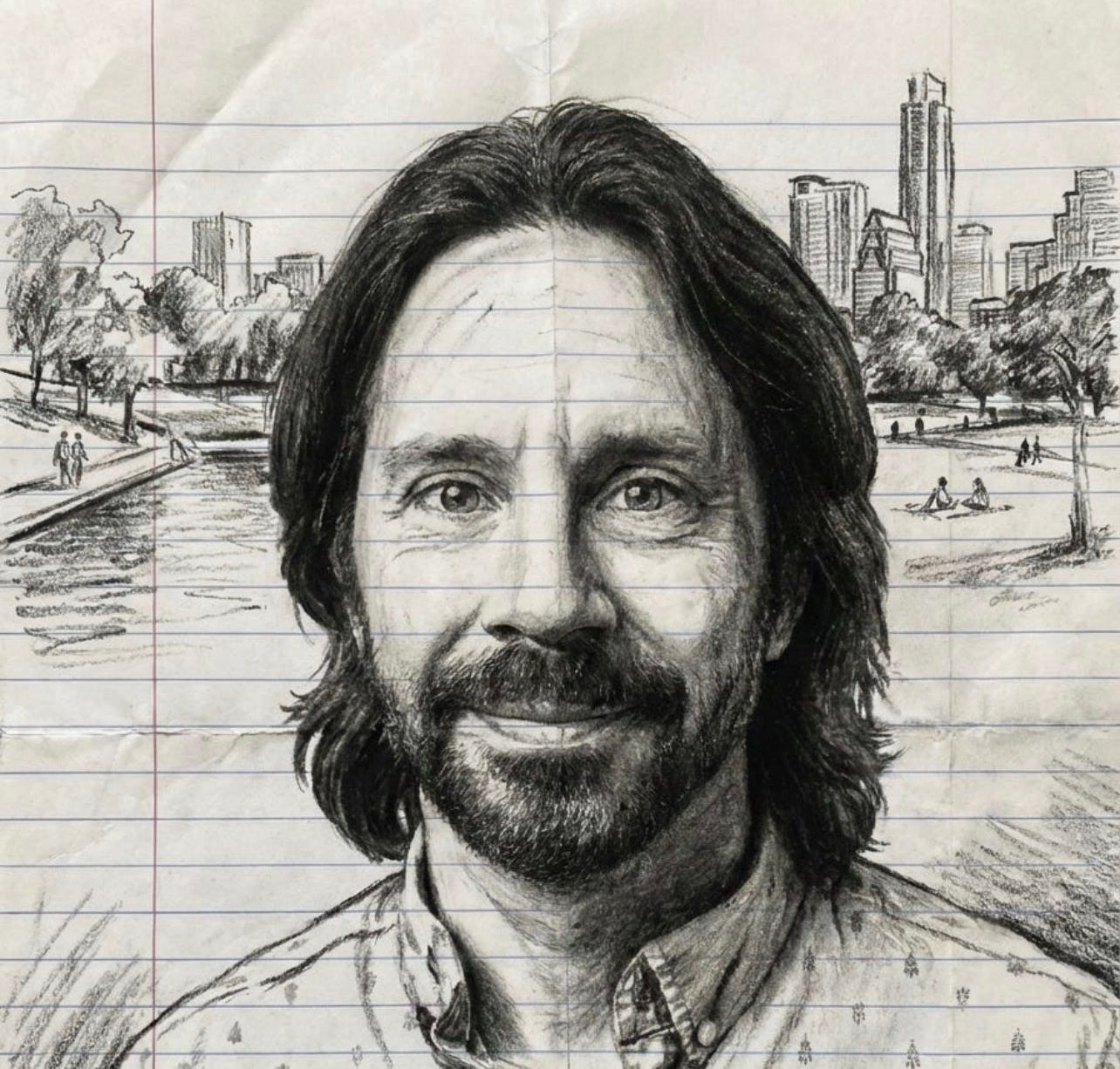
The author:
SB Corvus is a nerd. He grew up a gamer and still plays Mario Kart with his kids. He started writing as a kid, but didn’t start a serious writing journey until 2006, when he graduated from college. His first apartment was someone’s converted garage where he set up a little writer’s studio in a closet just wide enough to fit a desk and computer. He finished his first book back in 2008, tried to publish, realized he’d starve to death, and took an almost 20-year detour. Now he ekes out a few pages here and there either late at night or early in the morning so it doesn’t take time away from building Magic: The Gathering decks, gardening, vibe-coding with Claude, or spending time with his kids.
Where does your inspiration for these concepts come from?
My inspiration comes from my kiddos. Not because they talk about mile-high cities or dropouts stealing robots from college, but because I’m constantly anxious about what their future looks like. What will life be like when they’re adults? What happens to them if everything can be automated? Do we go through a decade or two of massive social unrest? If so, how do we prepare? Or is the transition through the Singularity smooth? I don’t know, but it keeps me up at night.
Why “Life with AI?” Well, I’ve also always been a bit obsessed with AI. That book I wrote back in 2008 was centered on AI. It was a sci-fi thriller, but the TL:DR was that humanity rounded up and shoved any self-aware AI they could find into a giant Faraday cage so they could continue to extract labor from the AI without having to worry about the moral implications of having essentially built a slave race. I’ve always just assumed AI will reshape the world. It’s just that what was sci-fi back in 2008 is no longer sci-fi.
That leads into my next question—what’s the core aim of your fiction? What are you trying to make the reader feel, confront, or experience? What gap are you trying to fill?
The core aim of my fiction is to explore a realistic picture of what’s to come. Not an all-chrome solarpunk utopia. Not an ash- and ruin-filled autocratic dystopia. I explore ideas that are realistically plausible with the advent of AI in the near term. In fact, everything I’m writing is technically possible with existing technology. They’re just massive engineering and orchestration problems. But I don’t want to just say, “Hey, look at all this cool stuff!” I want to show you a day in the life of people living in that future possibility. I want readers to confront the fact that if we accept the current status quo, we’ll fall far short. We need to be more creative in how we approach our social contracts and the physical ways in which we live and interact with the world.
As a writer, who are your biggest influences?
I’m a fan of Asimov, Arthur C. Clark, Frank Herbert, Michael Crichton, Tolkien, Brian Jacques. I love authors who really commit to the worlds they create.
What’s your opinion on modern literature as it currently stands?
A lot of modern literature is focused on quick reader capture and follows a typical progression from start to finish. Simplified heroes’ journeys with satisfying resolutions. But, generally, I think the writing is better than it was in the 90’s, but there were some writers in the 50’s and 60’s who saw SO far ahead, it’s mind-boggling. That kind of prescience feels like it’s missing these days.
And what about the age we live in more broadly? Does the world feel stranger to you lately? More unstable? More surreal?
The age we live in is objectively more unstable than the last five decades. Countries are moving away from globalization in favor of isolation, populism is broadly gaining traction, and misinformation has been normalized, if not outright encouraged. AI amplifies these trends and absolutely makes our social structures more unstable and our day-to-day more surreal. Still, I choose to be optimistic about the long-term impact. In the near term, I suspect we’ll face massive disruption as most governments and policymakers fail miserably to keep up with an exponential technology.
What are your biggest hopes and fears for the future of our civilisation?
I fear a civilisation-scale system shock. AI-forward countries will get hit by the step change first, as other countries fall dramatically behind. The reaction and agility of all countries and communities will determine the degree of social unrest caused by the disruption as AI goes from moving electrons (software) to moving atoms (robotics and infrastructure). Most of the current leadership (regardless of political party and in almost every country) suffers from short-term near-sightedness. They’re either “accelerate at all costs” or “no data centers in my backyard. Ever”. We should be thinking in generational terms, not in terms of the next election cycle.
What’s the greatest moment in your life been so far?
Three events. Marrying my wife and the birth of each of my children. Absolutely changed the course of my life. I know, I know. Cheesy. But it’s true.
What’s the most challenging one been? And what did you learn from it?
I almost lost my business. I’m a small business owner, and I learned I can’t wear all hats. I needed to let go of control and let others do what they do best while I focus on what I do best.
How do you balance your creative ambitions with the rest of your life?
Right now it’s a struggle. I sneak in bits of writing throughout the day. I used to go to bed at 8 PM and get up at 4 AM. I loved having all that time in the morning, but it put me too out of sync with my family and everyone else, kind of like living in a different time zone. Now I’m aiming for a consistent writing block from 9 PM to 11PM, and that works well enough. Not as productive as I’d like it to be, but I’m not going to compromise time with my family.
If someone discovered you through this interview, what’s the one piece you’ve posted on Substack that you’d point them toward first?
Probably Water. It’s the only piece on here that showcases where I’m really going with all of my writing. The current story, “The Candidate,” is about a character who later paves the way for The Arcology series. In that series, I want to take readers through the daily lives of people from all walks of life as they navigate life in a mile-high, self-sustaining, AI-optimized city. The Arcology series will be my main focus over the course of this year. It’s set in 2040 and assumes incredible scientific, engineering, and social advances occur within a very narrow timeframe. It’s my ode to a better future.
If SB Corvus’ answers resonated with you, be sure to subscribe to his Substack and do go check out Water. There’s a lot more going on beneath the surface than we could ever cover in a single interview.
Besides, now it’s your turn.
Which of SB’s answers struck you hardest? Which did you agree with? Which did you disagree with? And what question do you wish I’d asked?
Drop your thoughts below and let’s give SB a proper grilling in the comments. ↓
Thank you @TIBERIUS! Very much appreciate your efforts to highlight authors across Substack.
It takes some guts to write fiction about the near future.