
Voices from the Threshold #8
Jackson Houser


Jackson Houser is a writer whose quiet, contemplative prose impressed me with its remarkable powers of observation. His essays linger over the overlooked—finding humour, beauty, and humanity in the ordinary moments most of us pass by without a second thought.
In this interview, we discuss observation, humour, literature, Zen, morality, creativity, civilisation, and why becoming a better writer may begin with simply learning to pay closer attention.
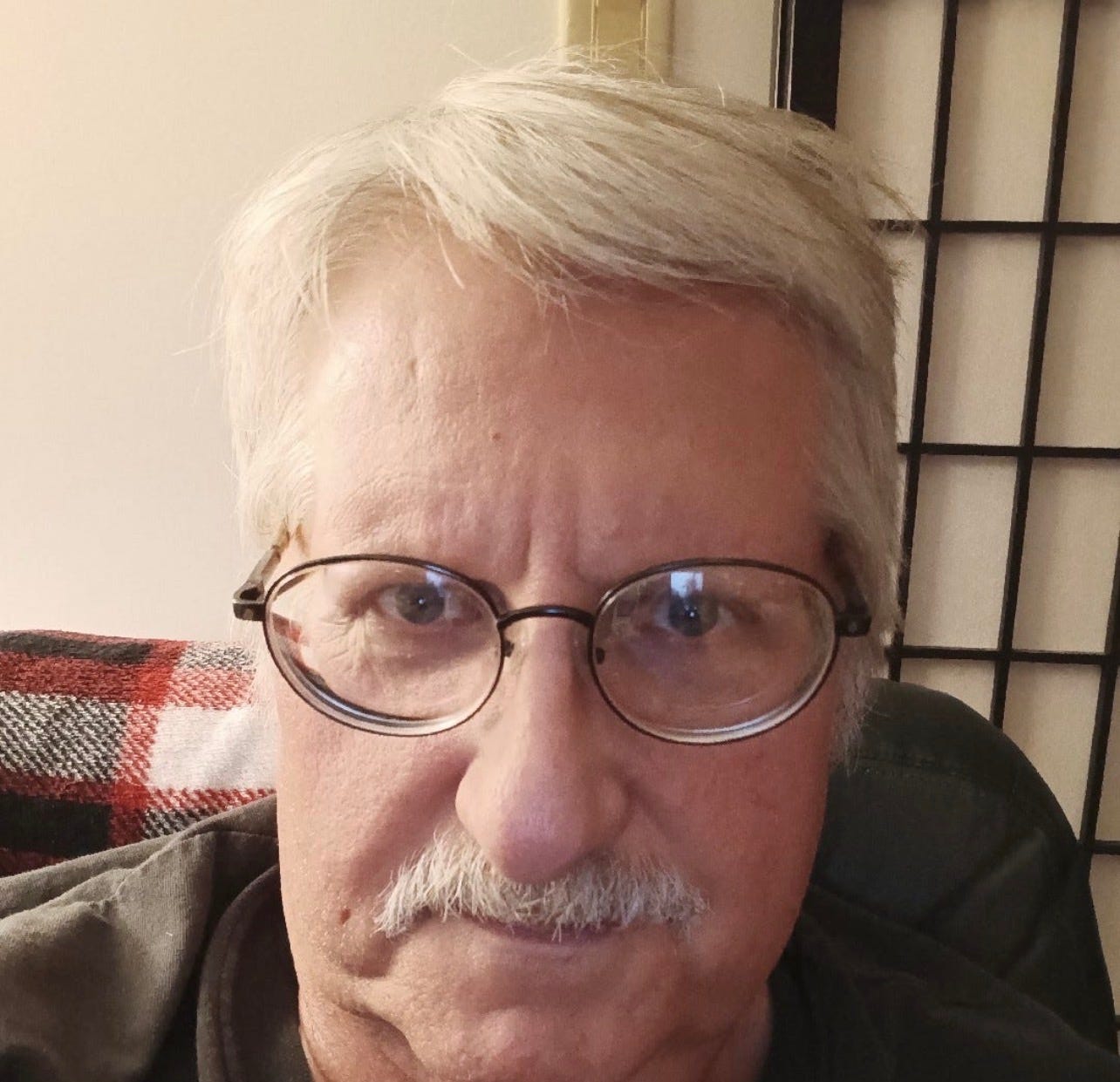
The author:
Jackson Houser has lived nearly all his life in eastern South Florida. He worked mainly as a hearing officer for the State of Florida. Retired, he now tends his garden and helps build houses.
Thanks for doing this interview, Jackson.
You are quite welcome. I am honored to be chosen for an interview. Please be gentle. My only other interviews have been for jobs. They do not go well, usually.
I really enjoyed reading your work. I was especially struck by the meditative grace of the piece. There’s something deeply humane and contemplative about the way you linger on strangers most people would pass without a second thought. Where exactly does that sensibility come from?
I have a morbid feeling that life is passing me by unnoticed. May I give you an example? Thanks. We had some iguana exterminators out to the house a little while ago. They spotted an iguana in the mahogany right away. I had seen nothing. It was embarrassing.
Alternatively, remember what Sherlock Holmes said in one of the early adventures: “You see, Watson, but you do not observe.” Every so often I remember to observe.
That leads into my next question—what’s the core aim of your fiction? What are you trying to make the reader feel, confront, or experience? What gap are you trying to fill?
I want the reader to feel like an observer, but a whimsical one.
As a writer, who are your biggest influences?
I did my Master’s thesis on H.L. Mencken, so you might think that he would be a great influence, and he is, in a way. You’ve read people who try to write like Mencken, sometimes unconsciously, influenced through an intermediary. I try not to write like him, as he wished. Robert Benchley, and those other Algonquin Round Table types—Dorothy Parker, Thurber, Woolcott—give some of the sensibility I want to convey. Alliterative Anglo-Saxon poetry, though I have read very little, is a big influence, at least the alliteration aspect. Also, Marianne Moore’s “The Pangolin.” I wish I could write like that. Oh, and since I think I see your eyelids getting heavy, I will just mention the dramatic monologues of Robert Browning and Frost. Apparently, if your first name is Robert, you have a good chance of being an influence on me.
What’s your opinion on modern literature as it currently stands?
This is one of those questions that I must confess to having too little information about to form a sound opinion. For example, a couple of years ago I read Elena Ferrante’s celebrated Neapolitan tetralogy and came away with the primary feeling that she has a knack: for writing annoying characters doing annoying things. No more Ferrante for me, though that is not an ironclad commitment. That opinion says more about me than about her or modern literature in general.
And what about the age we live in more broadly? Does the world feel stranger to you lately? More unstable? More surreal?
You undoubtedly know the punchline to the Zen koan: “Not the flag, not the wind; Mind is moving.” I feel the same way, I think: the world is as strange and surreal as it probably always has been and will be. I am recognizing it a bit more. Not enough.
What are your biggest hopes and fears for the future of our civilisation?
Biggest hope? That human civilization expands throughout the Solar System and beyond, peacefully, mostly. Biggest fear? That human civilization will not expand…No, my biggest fear for the future of our civilization is that anti-Modern, anti-freedom ideologies will become dominant; it won’t be forever, but it will seem like it.
What’s the greatest moment in your life been so far?
Gee, I wish I had read all the questions before starting to answer! Um, I have to answer a different question: “What’s the greatest moment in your life been so far, that you can talk about?” That way I can skip over my declaration of love (reciprocated, to my relief) and instead cite the reception of one of my Recommended Orders as a Reemployment Assistance (Unemployment Compensation) Special Deputy. The resulting decision made a difference in Florida, and perhaps the rest of the country. But I can’t say more about it than that.
What’s the most challenging one been? And what did you learn from it?
I was offered a Golden Opportunity in my career. I declined. It would have required me to break a pledged obligation, not one that was legally enforceable, but which I felt was morally binding. I learned that I could do things like that and be happy with the result, on net (meaning, yes, I do sometimes think, “How would things have been different if I had accepted?”).
How do you balance your creative ambitions with the rest of your life?
This is a good question! (That is the beginning of a long, rambling response that hopes you fall asleep before I have actually answered.) But the real answer is that too often I allow the rest of my life to outweigh my creative ambitions. I then try to make up for it, to the neglect of my life—for example, the elderly cat I inherited wants to go outside, as I write this. I keep putting her off. I will continue to put her off until I am done. It will not be good for the peace of the household.
If someone discovered you through this interview, what’s the one piece you’ve posted on Substack that you’d point them toward first?
“She Looked At Me, Expressionless.” June 23, 2025
But if you will permit me, my favorite is the dramatic monologue:
“The Abbess of the Ospedale della Pietà Speaks to Antonio Vivaldi, 1709. May 7, 2025
Alright—you get the last word. How would you like to sign off? What would you want to say to the people reading this?
Wake up! Even if my answers have lulled you to sleep, at least respect Tiberius for taking a chance with this interview. Keep reading him, whatever you think of me. But also, “WAKE UP!” (emphatically with the exclamation}: look around, if you can; listen, if you can; feel it, if you can; and write about it, even if you think you can’t.
If Jackson Houser’s answers resonated with you, be sure to subscribe to his Substack and do go check out The Abbess of the Ospedale della Pietà Speaks to Antonio Vivaldi, 1709. There’s a lot more going on beneath the surface than we could ever cover in a single interview.
Besides, now it’s your turn.
Which of Jackson’s answers struck you hardest? Which did you agree with? Which did you disagree with? And what question do you wish I’d asked? Drop your thoughts below and let’s give Jackson a proper grilling in the comments. ↓
 | A guest post by
|
Where did you find this guy to interview? He is not prolific, not a science fiction guy, and not, apparently, concerned with writing about the State Of Humanity, Now And In The Future. But he is very grateful to be included in your interview series, and grateful for the interview series as a whole. Thank you, and thank you for the Restack.
Really enjoyed this interview. Can definitely relate to the anxiety about feeling life is passing you by. That being said, Jackson, your answers imply you are more of a participant than you perhaps give yourself credit for. Looking forward to reading your work.